
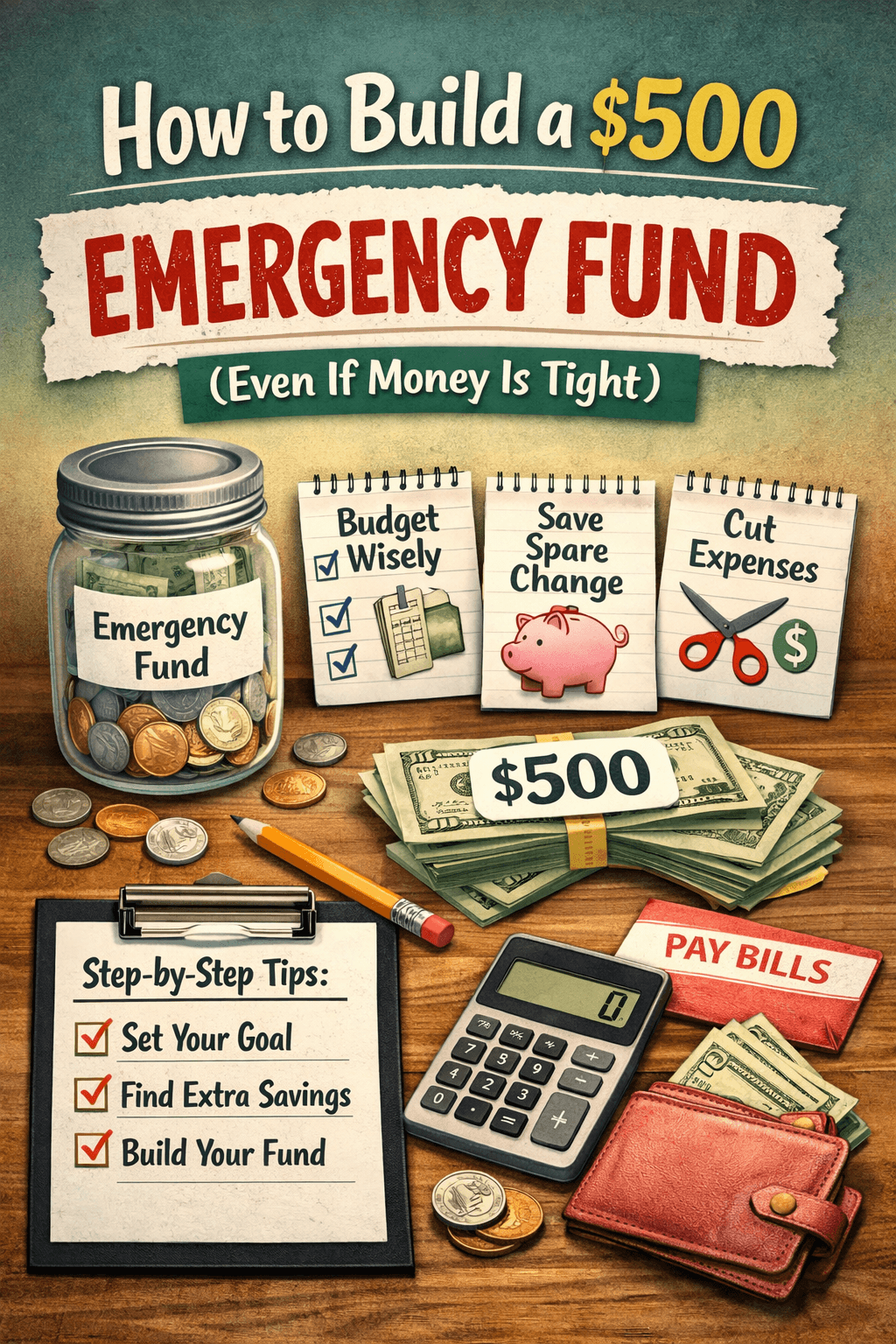
How to Build a $500 Emergency Fund (Even If Money Is Tight)
Life has a funny way of throwing curveballs; a flat tire, an unexpected medical bill, a broken appliance. These moments are stressful enough on their own. But when there's no financial cushion to catch the fall, they can feel catastrophic.
Here's the thing: you're far from alone. According to a 2024 survey by Empower, more than 1 in 5 Americans have zero emergency savings, and nearly 37% couldn't cover an unexpected expense of even $400. A recent Bankrate report found that only 47% of Americans could handle a $1,000 emergency from their savings alone. High inflation, rising costs, and stagnant wages have made saving feel nearly impossible for millions of households.
But here's the good news, building an emergency fund doesn't require a windfall or a raise. It starts with a small, realistic goal: $500. That single cushion can be the difference between a bad week and a financial spiral. Here's how to get there, step by step.
Why $500? Isn't That Too Small?
Financial experts often recommend saving three to six months of expenses, and that's absolutely the long-term goal. But for many people, that number feels so far away that they give up before they start.
Starting with $500 is powerful because:
- It's achievable in weeks or months, not years
- It covers the most common small emergencies (a car repair, a utility shutoff notice, a prescription)
- It creates momentum and builds the saving habit
- It keeps you from reaching for high-interest credit cards or loans for minor bumps
Think of it as your financial first aid kit. Once it's in place, you can start growing it.
Step 1: Open a Separate Savings Account (This Is Key)
The single most effective thing you can do is keep your emergency fund completely separate from your everyday checking account. When it's mixed in, it disappears, absorbed into groceries, a streaming service, or a moment of online shopping.
Look for a high-yield savings account (HYSA). Many online banks (like Robinhood Banking, Ally, Marcus by Goldman Sachs, or SoFi) offer these with no minimum balance and no monthly fees. Interest rates on HYSAs have been significantly higher than traditional savings accounts in recent years, meaning your money actually grows while it sits there.
Bonus tip: Name the account something meaningful, like "Emergency Only" or "Peace of Mind Fund." It sounds small, but it creates a psychological barrier that makes you less likely to dip in.
Step 2: Find Your Starting Number (Even If It's Just $5)
Many people get stuck waiting until they can save "a real amount." Don't wait. Here's a simple way to find your starting contribution:
The $5 Audit: Look at your last month of bank or credit card statements. Find one recurring expense you could pause, reduce, or eliminate, a subscription you forgot about, a habit spend (daily coffee runs, impulse purchases), or a service you underuse. Even $15–$25 a month adds up to $180–$300 a year.
Some other places people find hidden money:
- Unused subscriptions: streaming, apps, gym memberships. Apps like Rocket Money or Trim can scan your accounts and flag these automatically.
- Leftovers from your paycheck: even $10 per paycheck adds $260 a year if you're paid weekly.
- Grocery swaps: generic brands on staples like pasta, canned goods, and cleaning supplies can save $30–$50/month without much sacrifice.
- Energy savings: lowering your thermostat a few degrees or unplugging devices can shave $10–$20 off your monthly electric bill.
You don't need to overhaul your entire budget. Just find $20–$50/month to start.
Step 3: Automate It So You Don't Have to Think About It
This is where most people fail; not because they lack willpower, but because life gets busy. Automation removes the decision entirely.
Set up an automatic transfer from your checking account to your emergency savings account on the same day each month, ideally right after payday. Even $25 or $50 automatically moves over before you have a chance to spend it elsewhere.
This "pay yourself first" strategy is one of the most well-established principles in personal finance. According to Bankrate, those who automate savings are significantly more likely to actually hit their goals than those who transfer money manually.
Step 4: Give Your Fund a Boost With One-Time Windfalls
Regular contributions build the habit. But occasional windfalls can fast-track you to $500 faster than you'd expect. Any time extra money comes in, commit to sending at least half of it straight to your emergency fund before it disappears into the budget.
Places to look:
- Tax refunds: The average federal tax refund in 2024 was around $3,000. Even putting $250 from a refund toward your fund is a huge jump.
- Rebates and cashback apps: Apps like Ibotta, Fetch, or Rakuten pay real money for purchases you're already making.
- Selling things you don't use: Facebook Marketplace and OfferUp have made it easier than ever to turn unused items into cash. An old piece of furniture, electronics, or clothes can go directly into your fund.
- Side income: If your schedule allows, even occasional gig work (food delivery, pet sitting, freelance tasks) can bridge the gap. Apps like Rover, TaskRabbit, and Instacart make it easy to pick up hours when you have them.
- Employer benefits you may not be using: Some employers offer employee assistance programs (EAPs) or financial wellness benefits. It's worth checking with HR to see what's available.
Step 5: Explore Community Resources First
If you're already stretched thin, there may be programs in the Dallas/Fort Worth area that can help ease the pressure, freeing up money to start saving.
- Tarrant Area Food Bank and North Texas Food Bank provide free groceries, reducing your monthly food spend.
- Salvation Army DFW offers emergency financial assistance for utilities, rent, and more.
- Community Council of Greater Dallas connects residents with emergency aid programs.
- 211 Texas (just dial 2-1-1) connects you to a broad range of local assistance programs based on your specific situation and zip code.
- LIHEAP (Low Income Home Energy Assistance Program) can help with heating and cooling bills, reducing your monthly overhead.
Reducing how much you need to spend each month is just as powerful as earning more. These resources exist specifically to help people get back on stable footing.
Bonus: What To Do When an Emergency Hits Before You're Ready
Sometimes life doesn't wait. If you're hit with an unexpected expense before your fund is built, here's a quick priority order to consider:
- Ask about payment plans. Hospitals, utility companies, and even auto repair shops often offer installment options. Always ask before assuming you need to pay in full.
- Check community assistance programs. The resources listed above may cover the specific emergency you're facing.
- Ask family or friends. Borrowing interest-free from someone you trust, with a clear plan to repay, is often the least costly option.
- Explore 0% intro APR credit cards. If you have decent credit and the emergency isn't too large, some cards offer promotional periods with no interest.
- Look into installment or title loans as a last resort. If you need fast access to funds, companies like Check N Title offer installment loans and title loans in the DFW area. These can be a practical bridge when you're in a pinch, but it's important to understand the terms and have a clear repayment plan. Title loans and installment loans aren't the right fit for everyone, so make sure it aligns with your situation before moving forward.
You Don't Have to Get This Perfect, You Just Have to Start
Building an emergency fund when money is already tight takes patience, not perfection. Missing a month's contribution isn't failure. Dipping into the fund for a real emergency isn't failure, that's literally what it's for.
The goal is progress over time. Open the account. Set up the transfer. Start with whatever number you can. Every dollar you save is one less dollar you'll need to borrow someday.
And remember, the best time to build a financial cushion is before you need it. That $500 won't just cover an emergency. It'll give you something money rarely buys outright: a little peace of mind.
Check N Title has been serving the Greater Dallas/Fort Worth area for over 20 years, with 10 convenient locations. When you've explored your options and need fast access to funds, we're here to help. Apply online or call us today.